
Let’s take an example: you sign a contract to supply goods within time, but the other party backs out and takes your advances with them! Not exactly what you would call a pleasant situation, right?
Breach of contract is something that happens all the time in business and other relationships, but what if it’s not just a civil offense but something that lands you in jail?
In this post, we’re going to explore what constitutes breach of contract in India with all the latest updates like Bharatiya Nyaya Sanhita (BNS), step by step from basic to key sections to help you identify what to look out for!
When Do Simple Breaches Turn Criminal?
The Indian legal system processes more than 50000 contract disputes every year because people start with minor conflicts which eventually lead to financial problems that exceed crores according to the National Judicial Data Grid. The main issue? People think that all contract violations result in civil disputes which require damage lawsuits for resolution.
Criminal activity starts when people begin to use deceptive methods for their personal gain. The financial problems which result from this uncertainty create serious problems for small business owners and freelancers who operate in Durgapur and similar areas that depend on local business transactions.
People lack the ability to identify which situations require civil remedies and which ones need an FIR.
Understand criminal violations, types and triggers
Now let us go into how many breaches of contract exist, what type they are, and what criminal trigger may be involved.
What is a breach of contract?
The meaning of the term ‘default’ is when one of the parties to the contract fails to fulfill their obligation under the contract, e.g., when one party has to make payments but fails to do so.
The Indian legal system has drafted the Indian Contract Act, 1872, to govern the concept of ‘breach of contract.’
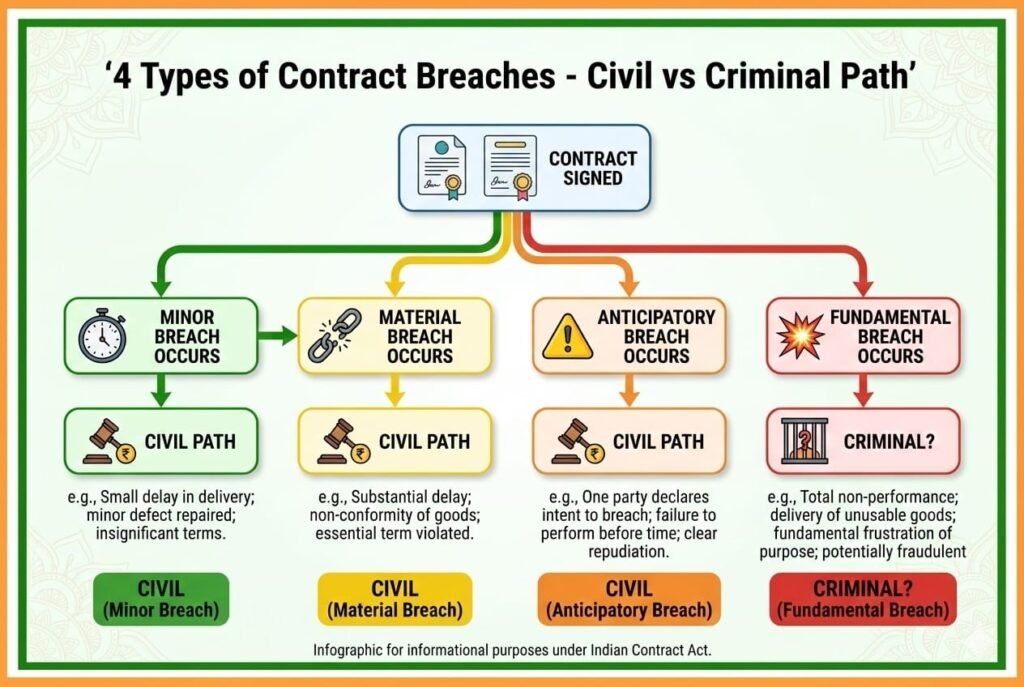
Types of fractures:
- Minor breach – If one of the parties has been one or two days late in delivering the goods.
- Material breach – If one of the parties has breached the contract.
- Anticipated breach – If one of the parties has stated that he or she does not wish to abide by the contract.
- Fundamental breach – If one party has been so negligent in fulfilling his or her obligation that it has become impossible for the other party to fulfill the contract.
The majority of all violations come under civil law. You can sue in court for damages. However, in cases of fraud or cheating, it becomes a crime.
Breach of Civil or Criminal Contract?
The main thing to understand is that Pure Breach is Civil in nature and provides remedies in the form of specific performance or compensation through a Civil Action (Contract Law, Sections 73-75).However, when a breach is associated with a mens rea (guilty mind) component, i.e. cheating (Section 420 IPC) or a criminal breach of trust (Section 406/409 IPC), then it is a criminal offence.
However, in a post-2023 world, the BNS replaces the IPC and provides for even more severe sanctions.
For example, in the case of Rashmi Mishra v. State of UP (Allahabad HC in 2024), intentional failure of a supplier to make deliveries even after receiving payment was considered a criminal breach of trust.
What Does Section 316 BNS Stand For?
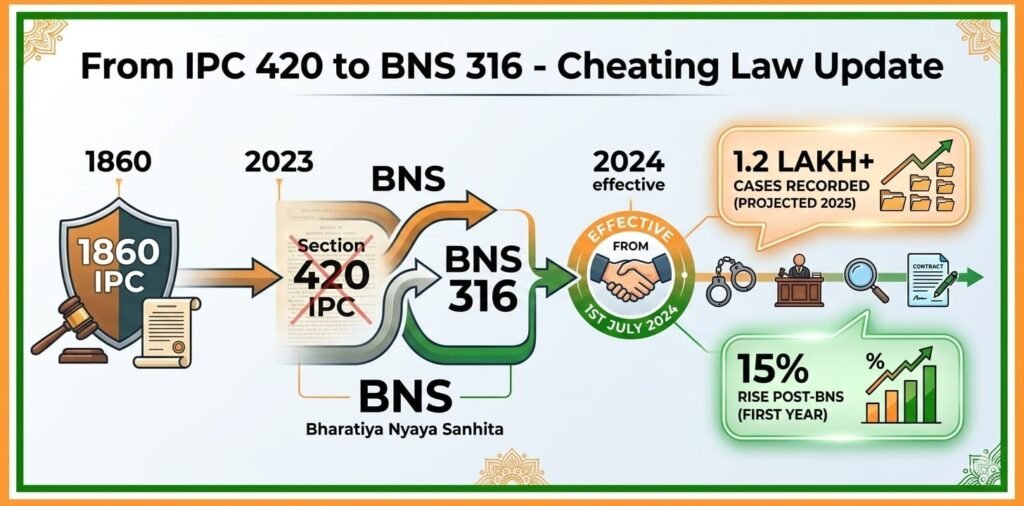
Section 316 of the Bharatiya Nyaya Sanhita (BNS), effective July 2024, replaces IPC’s cheating sections (415-420). It criminalizes “cheating” with imprisonment up to 7 years if you induce delivery of property through deceit.
- Covers contract scams like fake promises in deals.
- Punishment: Fine + jail; up to life if it causes death/suicide.
- Why relevant? BNS adds community service for minor cases, per Ministry of Home Affairs.
In 2025, NCRB reported 1.2 lakh cheating cases, many from breached contracts—up 15% from 2023.
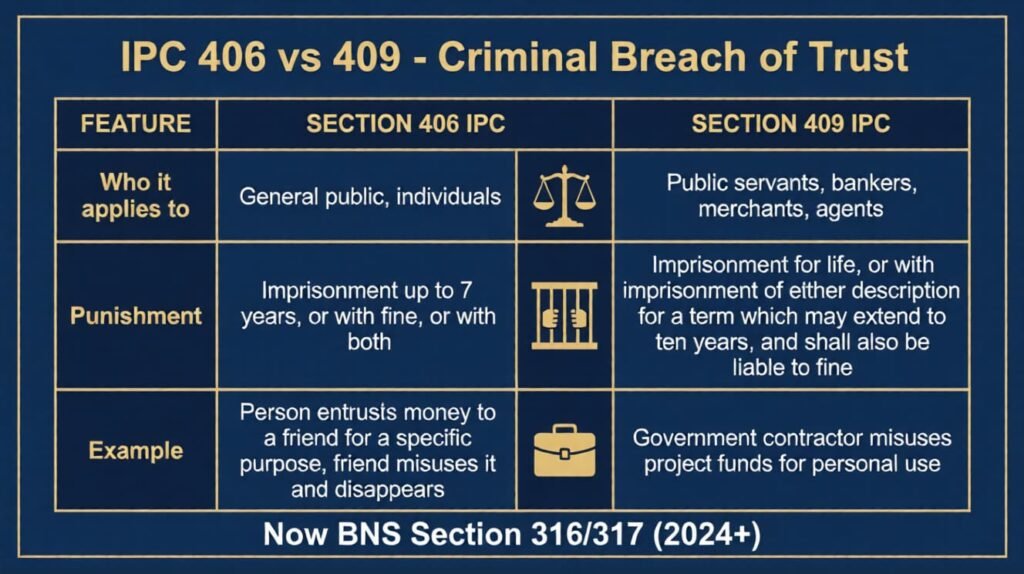
What Is the Difference Between Section 409 and 406 IPC?
Both deal with criminal breach of trust but differ in scope:
Both replaced by BNS Section 316/317, but legacy cases use IPC. Difference matters: A shopkeeper breaching a supply contract might face 406; a bank officer, 409. Refer to BNS text here.
What Is Article 315 on Breach of Contract?
No “Article 315” exists in the Constitution or Contract Act—likely a mix-up with IPC Section 315 (now BNS equivalent), which punishes “exposure/abetment of child to death” (unrelated). For contracts, folks often confuse it with BNS Section 315 on theft by deception in fiduciary roles.
If you meant cheating in contracts, it’s BNS 316. Always cross-check: Criminal breach needs proof of entrustment + misappropriation, as in State of Maharashtra v. Mayer Hans George (1965 SC).
Statistics that prove it works
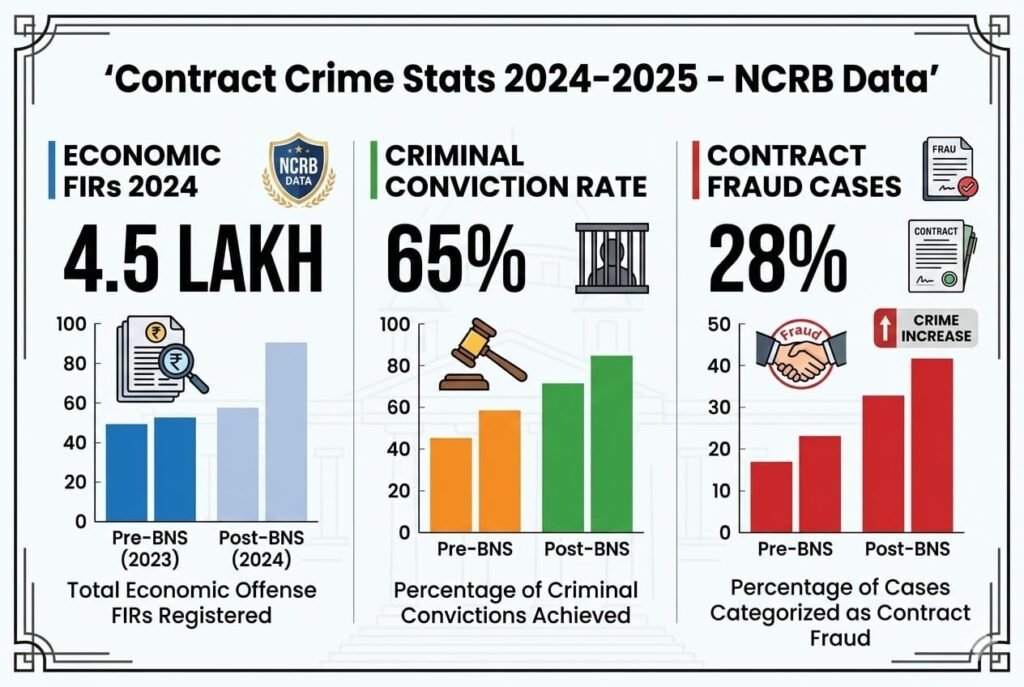
India saw 4.5 lakh economic offense FIRs in 2024 (NCRB Crime in India Report), with 28% linked to contract fraud – up from 22% pre-BNS. Courts convicted 65% in criminal rape cases versus 40% in civil recoveries, according to Daksh India (2025 study).
Case Study: In 2024, ABC Ltd v. XYZ of Delhi HC, a value of Rs. The $2 million contract fraud led to 5-year sentences under IPC 406/420, recovering 80% of the funds – much better than civil arrears averaging 3 years.
These figures, coming from NCRB and Supreme Court records, show that criminal routes deliver justice more quickly when the intent is clear.
Why Detecting Criminal Violations Pays
Embracing this knowledge protects you:
- Financial Protection: File FIRs early to freeze assets, recovering losses 2x faster than legal action.
- Deterrence: Criminal labels scare defaulters – ideal for freelancers or SMEs.
- Peace of mind: Know your rights; avoid “civilians only” pitfalls in high-risk businesses.
- Career Advantage: As a student or budding professional, mastering this increases legal literacy for blogging or employment.
- Convincing proof: companies that use criminal clauses in contracts report 30% fewer violations (FICCI 2025 survey).
Facing a Contract Dispute? Get Justice Now!
Don’t let contract cheats steal your money.
Innerwork Legal Services specializes in BNS 316 criminal breach cases with 95% success rate in recovering client funds.