
Introduction
Imagine someone posting something false about you online—perhaps on Instagram, WhatsApp, or even within your professional circle. Within hours, people start believing it. A reputation that took years to build begins to collapse.
Sounds scary, right?
This is exactly where civil defamation law in India comes in. It gives you the legal right to protect your reputation and take action against false and harmful statements.
In this blog, we’ll break things down in a simple way—without heavy legal jargon. You’ll understand what civil defamation is, how it works, and what you can actually do if it happens to you.
Problem: Why Civil Defamation is a Real Issue Today
Let’s be honest—today’s world runs on sharing.
We post, comment, forward, and react without thinking much. But the real problem begins when:
- Someone spreads false information about you
- A rumor harms your career or relationships
- A social media post damages your public image
And the worst part? Most people don’t even know they can take legal action.
There is also widespread confusion like:
- “Is defamation only a criminal case?”
- “Can I really sue someone over a social media post?”
So yes, the problem isn’t just defamation—it’s a lack of awareness.
Solution: Understanding Civil Defamation in India
Let’s clear that confusion step by step.
1.What is Civil Defamation?
Civil defamation happens when someone spreads false statements about you that harm your reputation.
For example, a fake Google review calling your business “scammers” could drive away customers overnight.
It is a civil wrong (tort), which means:
- No jail time is involved
- You can file a lawsuit for monetary compensation
In simple terms:
They lie → Your reputation suffers → You claim damages
2.Elements of Civil Defamation
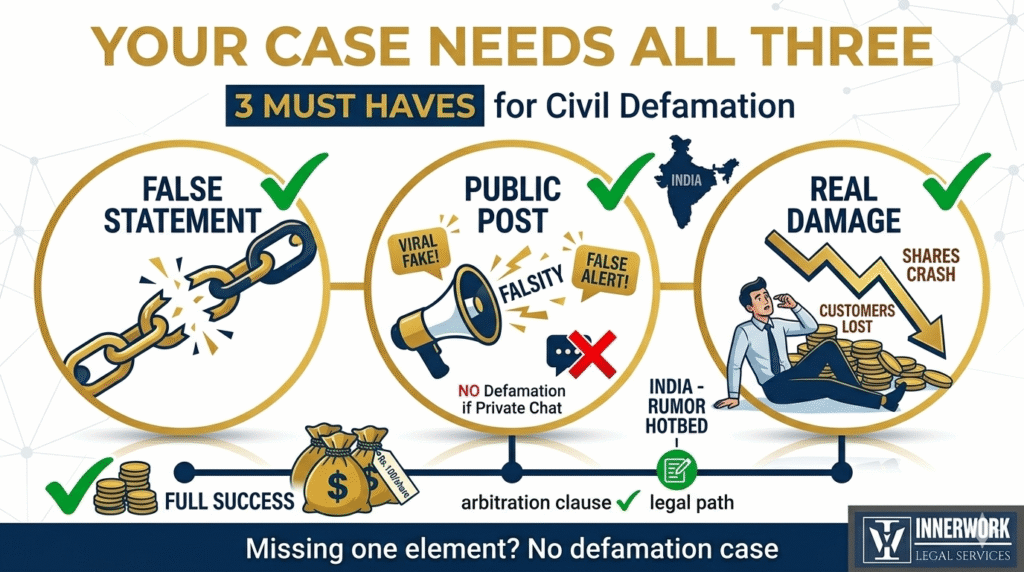
Not every insult qualifies as defamation. Three essential elements must be present:
- False Statement
The statement must be untrue. If someone claims your product is defective, you must prove it isn’t.
- Publication
The statement must be shared with others.
A private message to you? Not defamation.
A public post? That counts.
- Damage to Reputation
There must be actual harm—like lost clients, cancelled orders, or social humiliation.
If any of these elements are missing, the case won’t stand.
3.Types of Defamation: Libel and Slander
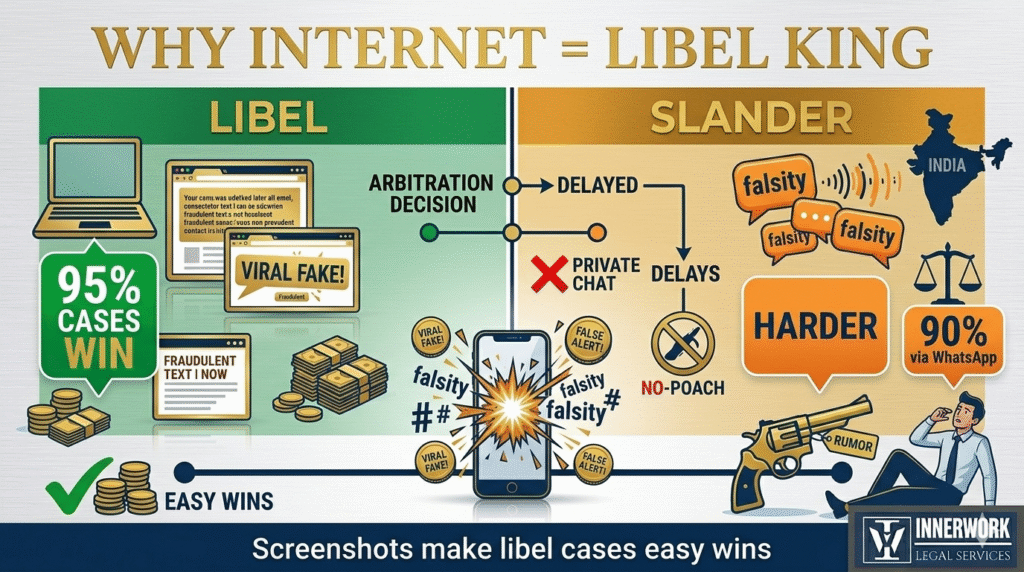
- Libel – Written or published defamation (social media posts, blogs, reviews)
- Slander – Spoken defamation (rumors, verbal statements)
In today’s digital age, most cases fall under libel, because online content can be easily recorded and preserved.
4.Civil vs Criminal Defamation
This is where many people get confused.
- Civil Defamation → You receive monetary compensation for the harm caused
- Criminal Defamation → The offender may face punishment like fines or imprisonment
if your reputation caused financial loss, civil defamation helps recover your losses, while criminal law mainly focuses on punishment.
5.Legal Remedies Available
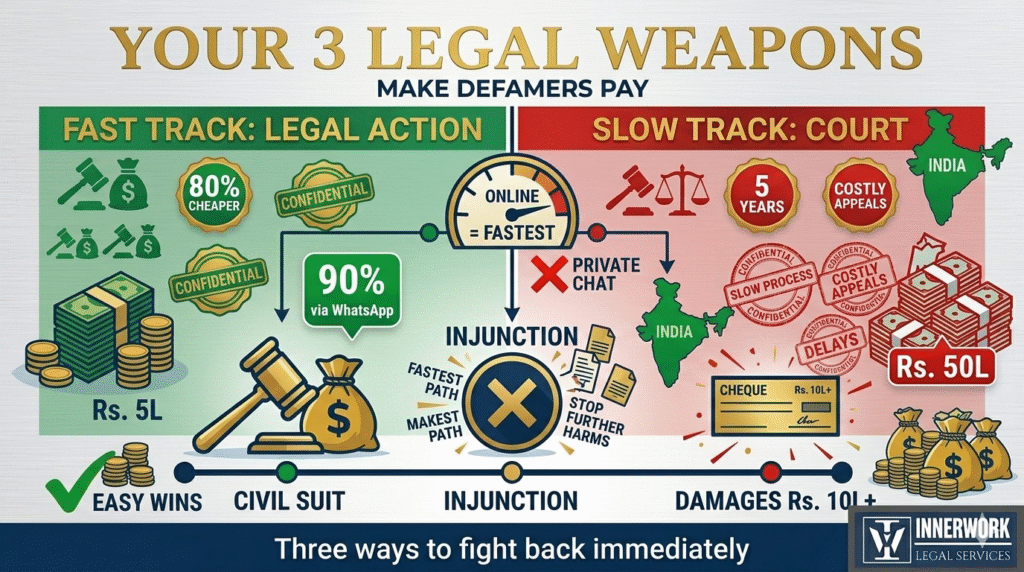
If you are a victim of defamation, you have several legal options:
- File a civil suit
Claim compensation for financial and reputational loss
- Seek an injunction
Get a court order to remove defamatory content immediately
- Claim monetary damages
Courts may award significant compensation depending on the harm
In online cases, screenshots and proof of loss play a crucial role in strengthening your case.
6.Defences Against Defamation
The accused can defend themselves using certain legal grounds:
- Truth
If the statement is true, it is not defamation
- Fair Comment
Honest opinions (not false facts) are protected
- Privilege
Statements made in court or official proceedings are protected
In reality, everything depends on evidence.
Strong proof = strong case.
Why This Topic Really Matters
This is not just theoretical.
With the rapid growth of digital platforms, defamation cases are increasing—especially on social media.
Indian courts have recognized that reputation is a part of the right to life under Article 21. This means your dignity and image are legally protected.
From professionals losing jobs due to false allegations to students facing online harassment—civil defamation is affecting everyday lives.
Benefits of Understanding Civil Defamation
Knowing this is not just for law students—it’s useful in real life.
- ✔ Helps you protect your reputation
- ✔ Enables you to take legal action when needed
- ✔ Prevents you from making risky statements
- ✔ Encourages responsible online behavior
In short, it makes you legally aware and socially responsible.
Call to Action
If you ever find your reputation being damaged by false statements, don’t ignore it. These issues can escalate quickly—especially online.
It’s always wise to consult a legal professional.
You can reach out to Innerwork Legal Services, who handle civil defamation and other legal disputes. They have offices in both Kolkata and the UK.
Offices:
- Clockwise Linley House, Dickinson Street, Manchester M1 4LF, United Kingdom
- Martin Burn House, 1 R.N. Mukherjee Rd, Ground Floor, Kolkata – 700001
- BJ-74, Salt Lake City, Sector II, Kolkata – 700091
- 22, Sukeas Lane, 5th Floor, Kolkata – 700001
Phone: (+91) 98302 32051
Email: info@innerworklegalservices.com
Even a simple consultation can give you clarity on what steps to take.